
Surviving the 21st Century
A Reality Check

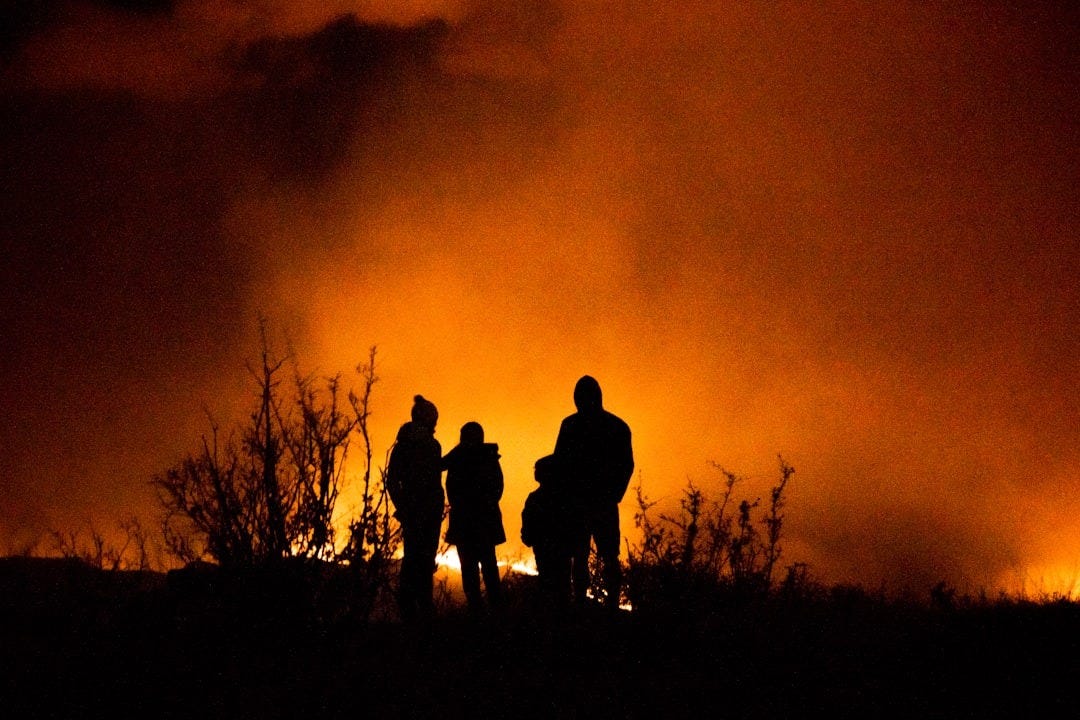
This year certainly started off with a bang in terms of climate disasters with wildfires burning large portions of Los Angeles, destroying thousands of homes, businesses, valuable wildlands and displacing tens of thousands of people. The fires are the worst disaster in LA history. The catastrophe joins a long list of catastrophic wildfires that have occurred throughout California, Canada and much of the rest of the world over the last few years, all part of the larger global warming pattern that includes droughts and floods.
Then we learn 2024 was the hottest year ever recorded, as was 2023 before it, and scientists are predicting 2025 could very well be hotter. Indeed, any hope of keeping the global temperature to 1.5º C above pre-industrial levels is now a pipe dream. At the rate we’re going we’ll be lucky to keep it to 2.5º C by 2030, which means the disasters we’re seeing now are just the preamble to what’s to come.
In the meantime, the great “energy transition” from fossil fuels to renewables also appears to be a pipe dream, as use of coal, oil and gas continues to increase despite increases in the use of renewable energy. Demand for energy increases faster than renewables keep up. And not helping is the ever-increasing number of data centres associated with artificial intelligence (AI) that have enormous energy needs. All this despite the promises to reduce emissions made at numerous climate conferences over the last many years by nations around the globe.
Then just to top it all off, the United States, the second largest emitter of green-house gases in the world (behind China), has just inaugurated a convicted felon, serial liar and climate change denier as president. On his first day in office, he reversed all the positive climate actions his predecessor President Biden had enacted to reduce emissions, clearing the way for the petroleum industry to “drill, baby, drill.”
So, gird your loins, folks. More disasters are coming thick and fast. Fresh water and food security will be huge issues for a lot more people in the not-so-distant future. And more desperate refugees will be appearing at our borders.
Now I know some of you are saying not to worry that technology will save the day—look at all we’ve accomplished with it so far—that AI is bound to come up with a solution that will allow us to continue on with our lives as we always have. And that’s what the petroleum industry is counting on to justify the emissions it generates. But so far, their attempts at things like “carbon capture and storage” are unproven and if viable would take years to build up to the scale necessary to make a dent in the ever-increasing carbon going into the air. What technology doesn’t take into account is that the 3.5-billion-year-old biosphere—that supports all life on earth, including us—follows rules of its own that we humans have long since ignored.
For example, during the 1970s to early ‘80s the human population of the planet reached its carrying capacity (3.4 to 5 billion people), or how many people the biosphere can sustainably support. Of course, we are well beyond that capacity now at over 8 billion people. As a result, our human population consumes 1.7 times more renewable resources than the biosphere can replace in a year. If that’s not the definition of unsustainability, I don’t know what is.
Indeed, studies have predicted that without significant change in our current trajectory of economic growth and resource consumption, societal collapse will occur sometime between 2040 and 2050. We might be seeing the beginnings of that now as the cost of food, housing and living generally rises. As well, politics are becoming ever-more divisive and more authoritarian governments are appearing around the globe.
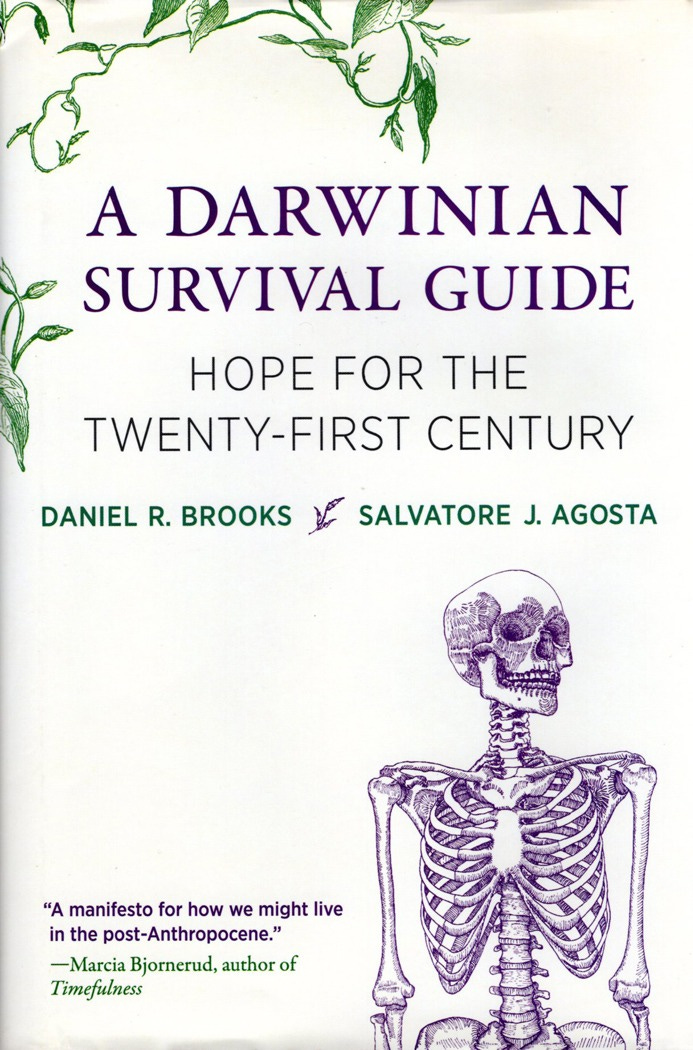
In 2024, evolutionary biologists Daniel Brooks and Salvatore Agosta published the book, A Darwinian Survival Guide, Hope for the Twenty-First Century (MIT Press). In it they explain how the indefinite growth of economies and populations is unsustainable, and if people wish to survive the coming collapse, they must change their behavior by falling back on the principals Charles Darwin described concerning species survival. It’s a tall order, given the prevailing attitudes people have about success in our society depending on increased consumption.
The book is over 300 pages, including an extensive list of references. The early chapters cover how humans evolved, created societies and larger and larger communities that eventually lost their connections with the land. That’s followed by chapters dealing with our current situation and how to turn it around. For a shorter read, an interview with Daniel Brooks in The MIT Press Reader is a good summary of what the book describes and decisions that people need to make.
Brooks emphasizes that he and Agosta are not talking about the survival of our species, Homo sapiens. The authors figure some form of human life will survive regardless of how the collapse occurs (unless of course there’s a thermonuclear conflagration). The question is whether those humans who do survive will carry with them some of the technology that’s improved our lives over the years (such as advancements in health, medicine and agricultural). In other words, are we going to go into the collapse continuing our current business-as-usual stance or are we going to start planning to survive the collapse with as much of our useful knowledge and technology intact as possible.
According to Brooks and Agosta, this must be done through local initiatives where people are willing to move away from trouble areas (for example, wildfire- or drought-prone areas) and develop small communities in more stable areas that think survival first—e.g., developing self-contained energy and food production systems that can be moved if the need arises. These are the people that will likely pass through the bottle-neck of the coming collapse and come out the other side as survivors. In many ways what the authors are discussing is what traditional indigenous communities have always been saying about living in harmony with the land and nature that gives us life.
I know, these are tough ideas to digest. Many people will not be willing to even try. But I’m one that believes it’s better to understand where we’re going, rather than just proceeding ahead as if everything is OK, because it’s obviously not. Preparing for the worst and hoping for the best is a good philosophy to follow.
As Brooks concluded in the interview:
“That first generation after 2050 is going to determine whether or not technological humanity reemerges from an eclipse, or whether Homo sapiens becomes just another marginal primate species.”
With a sustainable world population of humans around 5 billion, 50 years ago and a current population of 8 billion people, many living in poverty, it seems unlikely that our current standards of living are sustainable. With a life span of 70+ years, even if we stopped reproducing it would take a century to become a sustainable species. We need to reduce our 'wants' and greed for money and establish a sustainable future for our next generation. We need democratic reform and a shared economy.